 Narrative production workspace
 Reed
Write the story, test the branches, and prepare every language in one place.
An offline-first workspace for branching game dialogue. Your project never leaves your device.
Why Reed
Once a conversation branches, it stops being just dialogue. Reed holds the whole of it together, from the first draft to the game build.
The life of a single line
The workspace
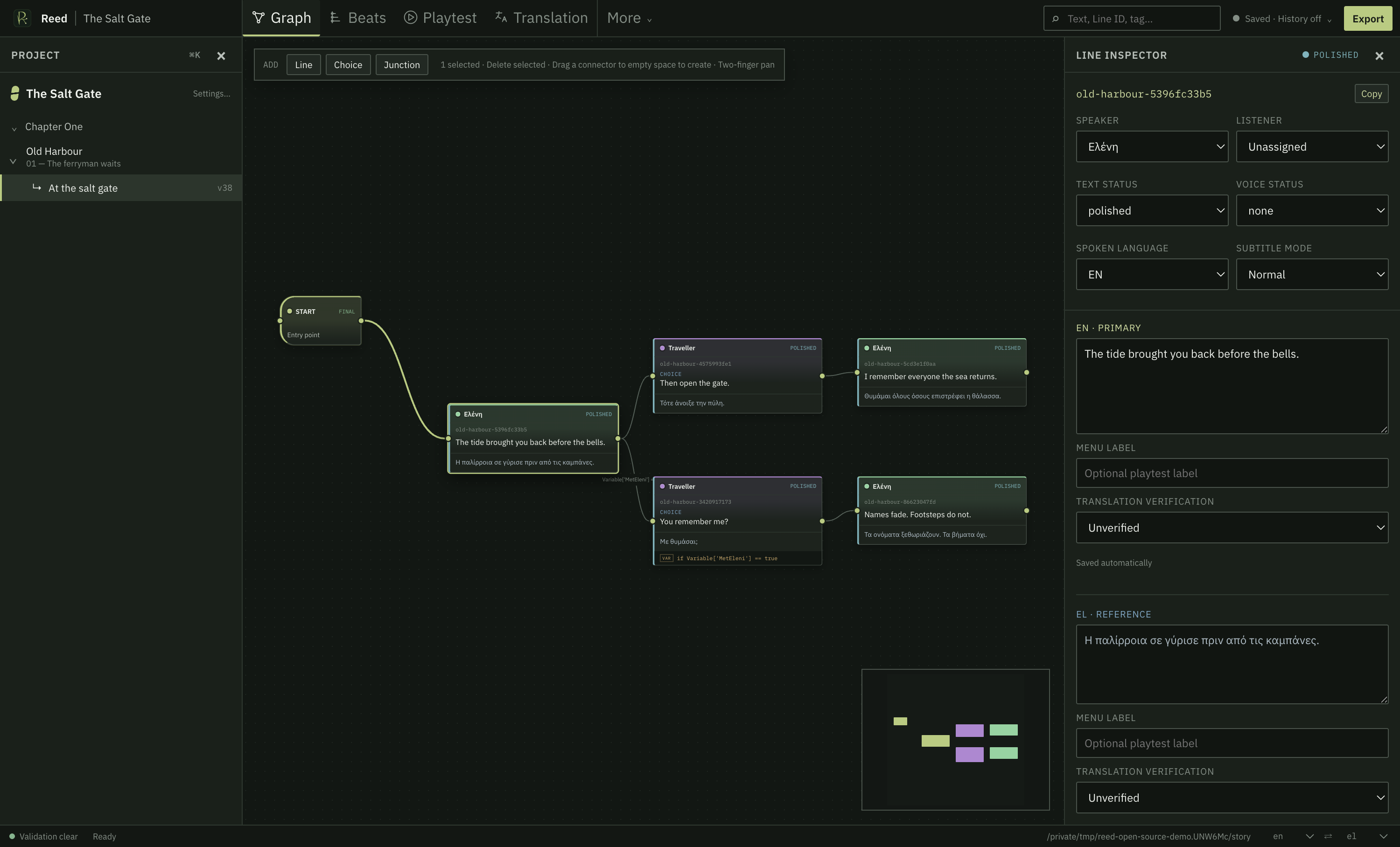
Write on a canvas, not in a spreadsheet.
Every line, choice, and branch sits on one canvas. You can see who is speaking, where a choice leads, and where a path runs out, all at a glance.
- Add a line, a choice, or a merge point wherever you need one
- Drag between nodes to connect them, or drop into space to make the next one
- Every line keeps one ID for life, so translations and recordings never lose it
Beyond the canvas
Read it, play it, and check it before the game ever sees it.
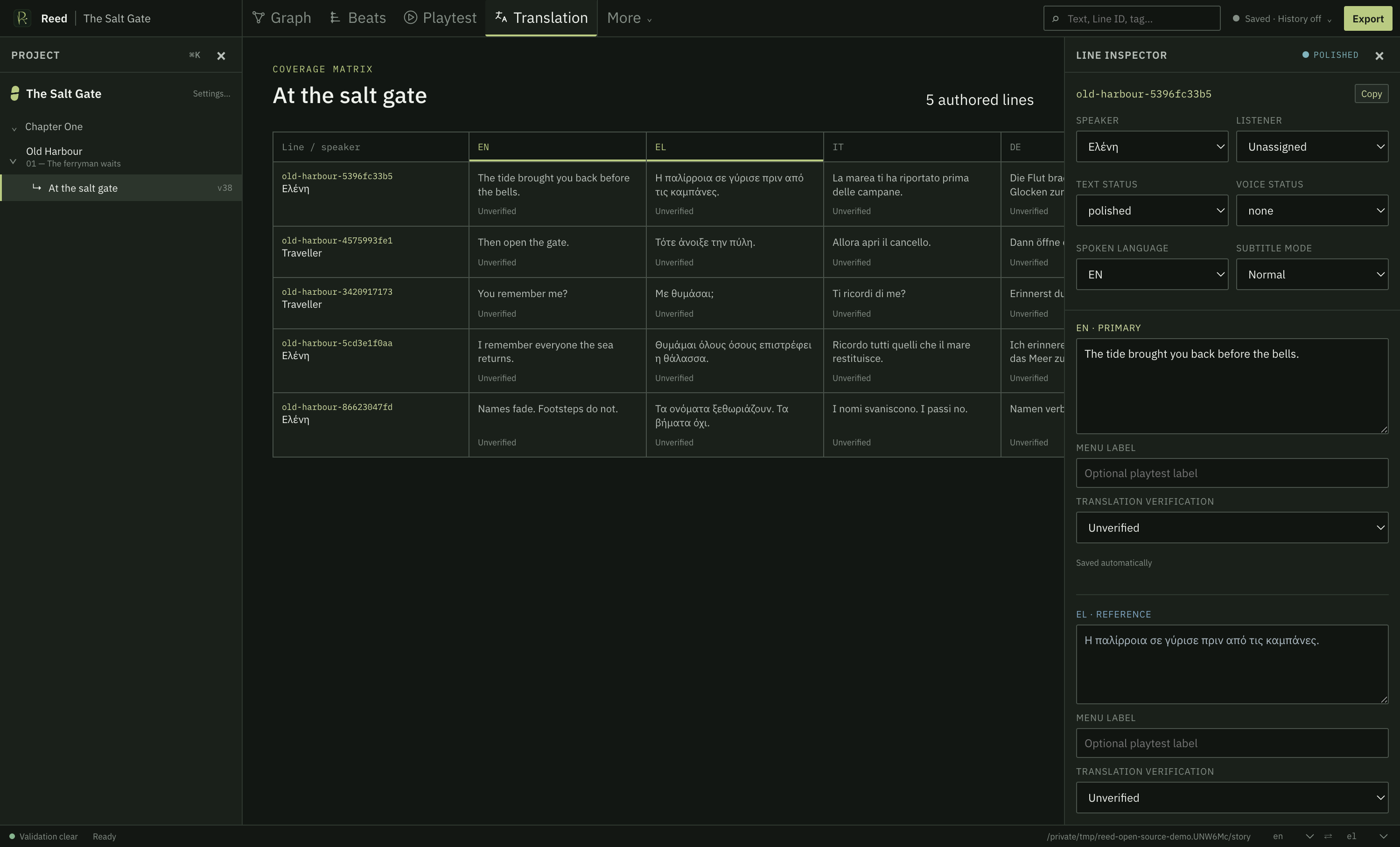
Write two languages side by side and see at a glance which lines still need work. 47 ready to go, including right-to-left and Asian scripts, or add your own.
Play it
Walk a conversation the way a player would, with every choice and condition working live.
Read it
Turn any path through the story into a clean script you can read start to finish.
Check it
Catch dead ends, unreachable lines, and missing translations before they reach a build.
Keep it safe
Automatic backups, named save points, and Git when a team needs it.
Who it's for
Read differently by everyone who touches the story.
- 01
Writers & narrative designers
Write a conversation like a conversation.
See who can say what and where each choice leads, without leaving the page you write on.
- 02
Solo & indie developers
One tool instead of six.
The inspector, the spreadsheets, the docs, and the export scripts all live in one place.
- 03
Distributed teams
Track changes without the fear.
Git and pull requests live inside Reed, so nobody has to open a terminal to collaborate.
- 04
Localization & translators
Translate in context, not in cells.
Each translation stays attached to its line, its speaker, and the choice it belongs to.
- 05
Voice directors & studios
Hand actors something they can use.
Scripts, direction, and the exact audio filenames, ready for the recording booth.
- 06
Technical devs & AI agents
Point your own agent at it.
Drive Reed from your scripts or an AI agent through the same safe actions as the editor.
CLI & MCP
Let an AI agent help, on your terms.
A small command-line tool and MCP server let Claude, or whatever agent you use, work on a project through the same safe actions as the editor. It can build branches, check the story, and generate exports.
What it can't do is quietly sign your writing off as finished, or reach the internet on its own. On a tablet, you switch its access on for a set time and off again. There is no model or account hidden inside Reed. You bring your own.
Handoff
Export what your engine already expects.
Every export stays local and uses permanent Line IDs as keys.
Unity
Localization CSV with stable IDs and locale columns.
Godot
UTF-8 localization CSV with readable context.
Unreal Engine
String Tables, one CSV per culture.
Yarn Spinner
One localization CSV per language.
Pixel Crushers
A full Dialogue Database for Unity.
gettext & XLIFF
PO catalogs and XLIFF 2.0 for CAT tools.
Screenplay
A readable Markdown script of any path.
Voice packages
Actor PDFs, a studio tracker, and filenames.
Reed JSON & CSV
Deterministic project data for anything else.
Free & donation-supported
Free to use. We built it because we needed it.
Reed exists because branching dialogue kept getting in our own way, so we made the tool we wished we had. It's free, offline-first, and open source, with no account, no subscription, and nothing locked behind a paywall. If it saves you time, a pay-what-you-want download on itch.io is what keeps it maintained. Any support, big or small, genuinely helps, and $0 is always okay.
Offline by design
Your work stays on your machine.
Reed has no account and no cloud. Writing, saving, testing, backing up, and exporting all happen on your own computer, offline. The only time anything leaves it is when you decide to push to Git or connect an agent.
Download Reed 0.2.0
Free. No account, no subscription.
Pre-1.0 software under the MPL-2.0. Keep backups and verify generated output against your engine and toolchain before shipping. Release notes & checksums →